
Texas Should Invest in Water Infrastructure
Texas has an estimated $32.7 billion surplus heading into its 2024-2025 biennium, presenting a generational opportunity to help Texas invest in water, wastewater, and flood/stormwater projects. A coalition of Texas water associations and key water stakeholders strongly encourages the State to invest in water infrastructure as outlined below. We also strongly support the Legislative Appropriations Requests and exceptional items for the Texas Water Development Board (TWDB), the Texas Commission on Environmental Quality, and the Public Utility Commission of Texas, which point to the critical need for investment in the Texas water workforce.
Why is investment in water infrastructure needed?
- Water infrastructure projects are critical for the health, safety, and economy of Texas.
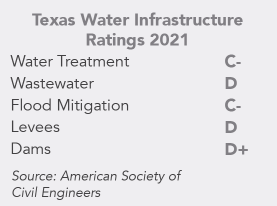
- Texas’ aging water infrastructure is in need of repair.
- Booming population growth is increasing demand for water infrastructure and creating new needs that may exceed long-range planning estimates.
- Increased frequency of extreme weather (drought, floods, freezes, etc) stresses water infrastructure and these events often expose a community’s vulnerability.
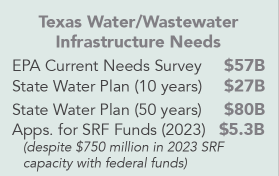
- Water infrastructure needs far exceed available funding capacity, and federal funds from the Bipartisan Infrastructure Law are insufficient to meet needs.
- Greater financial and technical assistance outreach is needed, especially to small and rural communities.
- Extreme water agency staffing shortages exacerbate process delays, adding significant costs to local projects. TWDB has the same number of staff to process financial applications as in 2013, before creation of SWIFT and the Flood Infrastructure Fund (FIF).
Water Infrastructure Funding Needs
Texas has large, unmet water and wastewater infrastructure needs.
State and federal financial assistance continues to pale in comparison to the billions needed for water infrastructure. Additional grants and longer loan repayment terms could help communities more cost-effectively finance water infrastructure projects to the benefit of ratepayers. In a recent survey, aging infrastructure was identified as the largest driver of new capital projects, followed by population growth and regulatory compliance. Needs exist across small, mid-size, and large regional projects to support both basic system maintenance and asset management, as well as new growth. Investment of state funds in water infrastructure – for both structural and nonstructural projects – is needed to ensure Texas communities can provide safe, clean water and keep up with growing demands into the future.
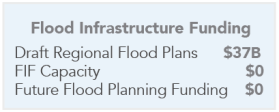
Flood and stormwater infrastructure funding is largely exhausted.
TWDB received over $2.4 billion in applications for the FIF, but the $793 million appropriated for projects will be exhausted soon. The state’s new regional flood planning process will cease after development of the state’s first state flood plan in 2024 if the state does not provide additional funding. Adding funds for both the planning process and project implementation would address infrastructure deficiencies, reduce inequality, and reduce risks to the public, first responders, and private property.
Investment in science and data is needed to guide water availability decisions and identify additional infrastructure needs.
Up-to-date and accurate data in the form of Water Availability Models (WAMs), Groundwater Availability Models (GAMs), water loss reports, hydrologic and hydraulic models, and planning figures is important to inform how much water is available and what infrastructure projects are needed.